Facts checked Article
Physical casino design
What online casino game offers the highest RTP?: where it sits and how many clicks it takes
No sheet can name the highest-RTP game across every lobby, because the figure is published per game, inside that game's own rules or information panel. This sheet records where the Gambling Commission's technical standards require the figure to sit and how far away the rules allow it to be. It then reads two games' figures side by side in pounds.
Which online casinos offer transparent RTP information for slot games?
Check 1 of 6 — the RTP figure: inside the game's own rules or information panel, before you commit to gamble.
The game with the highest RTP in any lobby is the one whose published figure is highest, and that figure is published one game at a time. Every online casino licensed in Great Britain must make it easily available before a customer commits to gamble. That is Remote gambling and software technical standard 3C, read 21 September 2026.
The information must include 'the return to player (RTP) percentage or the probability (likelihood) of winning events occurring', and the guidance names 'the average theoretical return to player percentage'. So the answer is not a game name. It is a route: open the game's information, read the figure, repeat for the next game.
This sheet did not inspect a named lobby. It records where the standard puts the figure and what a reader should expect to find on the way. Which operator is more transparent than another is not something the standard measures, and this sheet does not rank operators.
The standard applies to every remote licensee, so 'transparent RTP information' is a licence requirement rather than a feature of one casino. What varies is the route: the panel may open from the tile, from a menu, or only after the game has loaded.
What the standards require, as read on 21 September 2026
- RTP or probability
- Must be easily available before the customer commits to gamble (RTS 3C)Remote gambling and software technical standards (RTS): RTS 3, rules, game descriptions and the likelihood of winning · as checked on
- Which figure
- The guidance names the average theoretical return to player percentage, not a session resultRemote gambling and software technical standards (RTS): RTS 3, rules, game descriptions and the likelihood of winning · as checked on
- Where links should sit
- Prominently placed: gaming section home pages, game selection pages or menus, or within individual games (RTS 3A guidance)Remote gambling and software technical standards (RTS): RTS 3, rules, game descriptions and the likelihood of winning · as checked on
- Deposit limits
- A direct link on the homepage, clearly visible and accessible (RTS 12C)Remote gambling and software technical standards (RTS): RTS 12, financial limits · as checked on
- Promotion conditions
- Online, the significant conditions must be displayed in full no further than one click away (LCCP 5.1.9)LCCP condition 5.1.9: Other marketing requirements · as checked on
How can I check the RTP rates on online casino websites?
Check 2 of 6 — the game rules: the same place as the RTP figure, or one link away from the game.
The standard ties the figure to the rules. RTS 3A states that 'an explanation of the applicable rules must be easily available to the customer before they commit to gamble'.
Its guidance says links 'should be prominently placed, for example on home pages for gaming sections, game selection pages or menus, or within individual games, so that customers can easily locate them'. The RTP figure is one of the items that explanation must carry.
In practice the path string is usually short. Lobby › game tile › information or rules panel › the percentage. Some panels open before the game loads; others only after it.
The standard does not state a click count, so the number of clicks is an observation to make, not a rule to quote.
Write the figure down with the game name and the date. A figure without a date is not evidence, because the panel can change.
How to read and compare two games' RTP figures
The steps restate RTS 3 and LCCP 8.1.1 as read on 21 September 2026. No lobby was inspected for this sheet, so the click count is an observation for the reader to make.
Confirm the licence statement first
Before reading any figure, check that the site states it is licensed and regulated by the Gambling Commission, shows its account number and links to its current licensed status (LCCP 8.1.1). If that statement is absent, nothing on this sheet describes the site.
Open the game's information panel
From the lobby, open the game tile, then its information or rules panel. Some panels open before the game loads; others only after it.
Read the RTP percentage
The panel must carry the return to player percentage or the probability of winning events. The guidance names the average theoretical return to player percentage, not a session result.
Write it down with the game name and date
A figure without a date is not evidence, because the panel can change.
Repeat for the next game
The game with the highest RTP in a lobby is the one whose published figure is highest, so the figures are compared one game at a time.
What the result means
For the same total staked, the higher figure has the lower long-run average cost: £20 at 96.0% has a long-run average cost of £0.80, and at 92.0% it is £1.60. It is a long-run average across all players, not a forecast for one session.
How to locate game RTP percentages on casino websites?
Check 3 of 6 — the licence statement: on the operator's site, with a link to its current licensed status.
Before reading any figure, confirm the regime the figure sits under. A remote casino licensee must display 'a statement that they are licensed and regulated by the Gambling Commission' and its account number. It must also link to its current licensed status on the Commission's website.
That is condition 8.1.1 of the Licence Conditions and Codes of Practice (LCCP). If the statement is absent, RTS 3 does not apply to the site, and nothing on this sheet describes it.
Check 4 of 6 — the terms: made available in an easily accessible way.
LCCP 7.1.1 requires terms to be 'made available to customers in an easily accessible way' and transparent within the meaning of the Consumer Rights Act 2015. It does not say where. The location is an observation; the requirement is the accessibility.
Sources: LCCP condition 8.1.1: Display of licensed status (remote operators); LCCP condition 7.1.1: Fair and transparent terms and practices; Remote gambling and software technical standards (RTS): RTS 12, financial limits; LCCP condition 3.3.1: Responsible gambling information; Help for problems with gambling.
Terms on this sheet
- RTS
- The Remote gambling and software technical standards: the Gambling Commission's technical rules for online gambling, numbered by topic, such as RTS 3 and RTS 12.
- Information panel
- The game's own rules or information screen, where RTS 3 puts the rules and the RTP figure.
- Path string
- The breadcrumb this site writes for a location, such as Lobby › game tile › information panel, so a reader can follow it.
- Cooling-off period
- The wait before a higher deposit limit takes effect: at least 24 hours, then a positive confirmation, under RTS 12C.
- Self-exclusion
- Barring yourself from gambling with an operator. LCCP 3.3.1 requires information on self-exclusion options to be available.
Checks 5 and 6 of 6 — the deposit-limit control and safer-gambling help: a homepage link, then availability
Check 5 of 6 — the deposit-limit control: a direct link on the homepage.
RTS 12C is the one standard in this set that names a place. Financial limit facilities 'must be provided via a direct link on the homepage and be clearly visible and accessible'. Increases take effect only after a cooling-off period of at least 24 hours and a positive confirmation.
Support: GamCare, 0808 8020 133, free, 24 hours a day.
Check 6 of 6 — safer-gambling information: available, with self-exclusion options and where to get help.
LCCP 3.3.1 requires information on measures to monitor or control gambling, timers or reality checks where available, self-exclusion options and 'the availability of further help or advice'. The page read states placement rules for premises; for a website it requires availability rather than a fixed position.
Sources: LCCP condition 8.1.1: Display of licensed status (remote operators); LCCP condition 7.1.1: Fair and transparent terms and practices; Remote gambling and software technical standards (RTS): RTS 12, financial limits; LCCP condition 3.3.1: Responsible gambling information; Help for problems with gambling.
The comparison table
The table sets each check beside the rule that governs it, the place the rule names, and the distance the rule states. 'Not stated' means the rule requires availability without naming a position; the clicks are then an observation for a reader with a lobby open, not a figure this sheet can supply.
Sources: Remote gambling and software technical standards (RTS): RTS 3, rules, game descriptions and the likelihood of winning; LCCP condition 8.1.1: Display of licensed status (remote operators); LCCP condition 7.1.1: Fair and transparent terms and practices; Remote gambling and software technical standards (RTS): RTS 12, financial limits; LCCP condition 3.3.1: Responsible gambling information; LCCP condition 5.1.9: Other marketing requirements.
| Check | What to look for | Where the rule puts it | Distance the rule states | Rule | Evidence |
|---|---|---|---|---|---|
| 1 of 6 | RTP percentage or probability of winning events | Within the game information, easily available before you commit to gamble | Not stated as clicks; 'easily available' | RTS 3C | · Remote gambling and software technical standards (RTS): RTS 3, rules, game descriptions and the likelihood of winning |
| 2 of 6 | Game rules and description | Links prominently placed: gaming section home pages, game selection pages or menus, or within individual games | Not stated as clicks; 'prominently placed' | RTS 3A | · Remote gambling and software technical standards (RTS): RTS 3, rules, game descriptions and the likelihood of winning |
| 3 of 6 | Licence statement, account number, link to licensed status | On the operator's site | Not stated | LCCP 8.1.1 | · LCCP condition 8.1.1: Display of licensed status (remote operators) |
| 4 of 6 | Terms and conditions | Made available in an easily accessible way | Not stated | LCCP 7.1.1 | · LCCP condition 7.1.1: Fair and transparent terms and practices |
| 5 of 6 | Deposit or spend limit facility | A direct link on the homepage, clearly visible and accessible; also on deposit pages | One link from the homepage | RTS 12C | · Remote gambling and software technical standards (RTS): RTS 12, financial limits |
| 6 of 6 | Safer-gambling information and self-exclusion options | Available to customers; premises rules name positions, the remote rule names availability | Not stated for websites | LCCP 3.3.1 | · LCCP condition 3.3.1: Responsible gambling information |
| Also | Significant conditions of a promotion | At the point of sale; online, in full no further than one click away | One click | LCCP 5.1.9 | · LCCP condition 5.1.9: Other marketing requirements |
A worked example in pounds
The figure lets a reader compare two games on one number. The percentage is a long-run average across all players and all spins, not a forecast for one session, and one session can end anywhere. Reel & Story's pages explain what the figure is; this sheet only shows how to read two of them side by side.
Take £20 staked in total, which is the stake this network uses for examples. At a published figure of 96.0%, the long-run average cost of that £20 of play is £20 × (100 − 96.0) ÷ 100 = £0.80. At 94.0% it is £1.20.
At 92.0% it is £1.60. The three percentages are illustrations; they are not the figures of any named game, and a reader should use the ones on the panels in front of them.
The working is the same for any stake. The difference between two games' figures, applied to the total staked, is the long-run difference in cost. It is not money a reader will receive.
If the comparison is turning into a reason to stake more, the deposit-limit control from Check 5 is one link from the homepage, and GamCare is on 0808 8020 133.
Sources: Remote gambling and software technical standards (RTS): RTS 3, rules, game descriptions and the likelihood of winning; Remote gambling and software technical standards (RTS): RTS 12, financial limits; Help for problems with gambling.
Long-run average cost of a stake at a published RTP
Enter the total you would stake and the theoretical RTP figure from the game's information panel. The output is the long-run average cost of that play, not a prediction for a session.
Worked example: with total staked £20.00, published rtp 96.0%, long-run average cost of this play is £0.80. £20 at 96.0% has a long-run average cost of £0.80; at 92.0% the same £20 costs £1.60 on average.
Formula and figures: Remote gambling and software technical standards (RTS): RTS 3, rules, game descriptions and the likelihood of winning
The RTP figure is the average theoretical return to player percentage that RTS 3C requires to be available before you commit to gamble.
What this page does not tell you
It does not name the game with the highest RTP anywhere, because no published source lists every game's figure across every lobby, and the figure is per game. It does not report click counts from a real lobby: no inspection was made for this sheet, and a count that was not observed is not written down here.
It does not tell you whether a game's figure can differ between operators. Some standards discussions mention configurable versions, but none of the pages read for this sheet states it, so this sheet does not either.
What this sheet leaves to sibling sites
- It does not explain what RTP is or how it is calculated; Reel & Story owns that.
- It does not tell you what a bonus term means; Terms in Plain Sight owns that.
- It does not cover the same checks on a phone; Pocket Casino Lab measures those.
Questions answered
Each answer gives the finding first, from the rule read on 21 September 2026.
Sources: Remote gambling and software technical standards (RTS): RTS 3, rules, game descriptions and the likelihood of winning; LCCP condition 7.1.1: Fair and transparent terms and practices.
Questions answered
Are there tools or websites that verify RTP values for online slots?
This sheet does not assess third-party tools. Under RTS 3C the operator itself must make the theoretical RTP or the probability of winning events easily available before you commit to gamble. The primary place to read the figure is therefore the game's own information panel on a GB-licensed site.
How to verify the stated return to player rate for a slot game?
Read it from the game's rules or information panel, note the game name and the date, and compare it with the same panel on another day or another game. The figure is a long-run theoretical average, so a session result cannot confirm or contradict it.
Where do online casinos usually display their terms and conditions?
LCCP 7.1.1 requires terms to be made available in an easily accessible way but does not name a position. The location is therefore an observation for each lobby, and this sheet did not count clicks for any named site.
Source: LCCP condition 7.1.1: Fair and transparent terms and practices
Sources checked 21 September 2026
Sources checked 21 September 2026. All pages are published by the Gambling Commission unless stated, and were read over HTTPS on that date.
Support: GamCare, 0808 8020 133.
Sources: Remote gambling and software technical standards (RTS): RTS 3, rules, game descriptions and the likelihood of winning; Remote gambling and software technical standards (RTS): RTS 12, financial limits; LCCP condition 5.1.9: Other marketing requirements; LCCP condition 8.1.1: Display of licensed status (remote operators); LCCP condition 3.3.1: Responsible gambling information; LCCP condition 7.1.1: Fair and transparent terms and practices; Help for problems with gambling.
Sources and captures
No captures were made for this sheet; the ledger lists the rules read on 21 September 2026.
| Source | Publisher | Read on | Re-check due | Note |
|---|---|---|---|---|
| Remote gambling and software technical standards (RTS): RTS 3, rules, game descriptions and the likelihood of winning | Gambling Commission | On the next revisit | ||
| Remote gambling and software technical standards (RTS): RTS 12, financial limits | Gambling Commission | On the next revisit | ||
| LCCP condition 5.1.9: Other marketing requirements | Gambling Commission | On the next revisit | ||
| LCCP condition 8.1.1: Display of licensed status (remote operators) | Gambling Commission | On the next revisit | ||
| LCCP condition 3.3.1: Responsible gambling information | Gambling Commission | On the next revisit | ||
| LCCP condition 7.1.1: Fair and transparent terms and practices | Gambling Commission | On the next revisit | ||
| Help for problems with gambling | NHS | On the next revisit |
Rules read for this sheet, numbered as cited
- 1. Remote gambling and software technical standards, RTS 3: rules, game descriptions and the likelihood of winning.
- 2. RTS 12: financial limits.
- 3. LCCP condition 5.1.9: other marketing requirements.
- 4. LCCP condition 8.1.1: display of licensed status (remote operators).
- 5. LCCP condition 3.3.1: responsible gambling information.
- 6. LCCP condition 7.1.1: fair and transparent terms and practices.
- 7. Help for problems with gambling, NHS, for the National Gambling Helpline number.
Questions answered
Are there tools or websites that verify RTP values for online slots?
This sheet does not assess third-party tools; under RTS 3C the operator must make the theoretical RTP or probability easily available before you commit to gamble, so the game's own panel is the primary place to read it.
How to verify the stated return to player rate for a slot game?
Read it from the game's information panel with the game name and date, and compare it with the same panel later; a session result cannot confirm or contradict a long-run theoretical average.
Where do online casinos usually display their terms and conditions?
LCCP 7.1.1 requires terms to be easily accessible but names no position, so the location is an observation per lobby; this sheet did not count clicks for any named site.
Design sources
- Remote gambling and software technical standards (RTS): RTS 3, rules, game descriptions and the likelihood of winning
- Remote gambling and software technical standards (RTS): RTS 12, financial limits
- LCCP condition 5.1.9: Other marketing requirements
- LCCP condition 8.1.1: Display of licensed status (remote operators)
- LCCP condition 3.3.1: Responsible gambling information
- LCCP condition 7.1.1: Fair and transparent terms and practices
- Help for problems with gambling
Continue reading
Reading a casino route: a wayfinding worksheet
Follow the decisions a room asks you to make. This worksheet turns a casino design description into questions that can be checked.
Read Reading a casino route: a wayfinding worksheet
A casino marketing screen needs to show both what and how
An interface inspection of product choices, contact channels and confirmation steps, using a fictional preference screen and the published consent requirements.
Read A casino marketing screen needs to show both what and how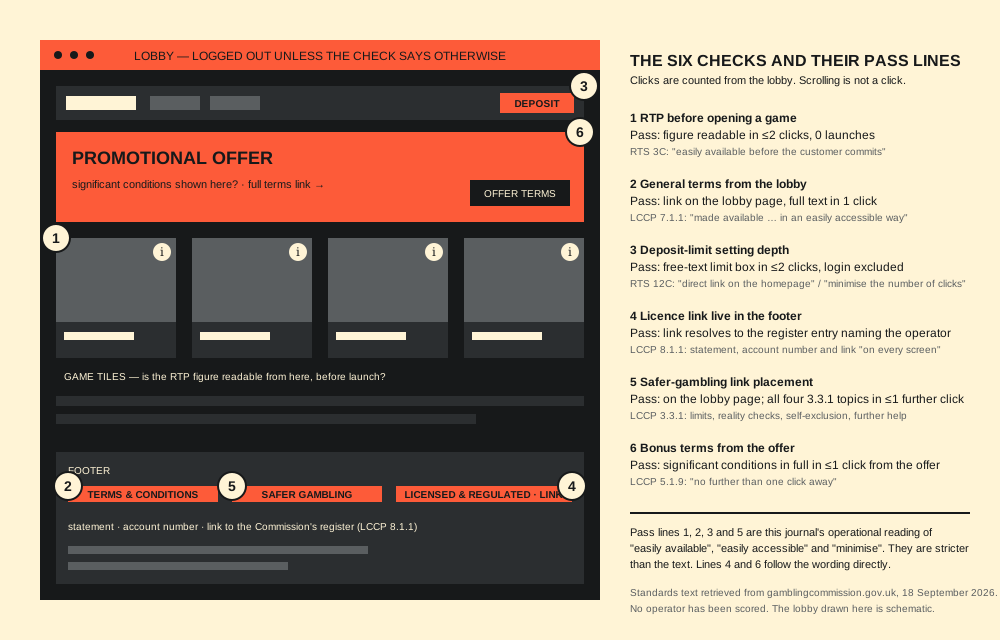
How to find RTP and terms inside an online casino, and how far away they are allowed to be
Six pieces of information a UK casino lobby is obliged to make reachable, the route to each on a desktop screen, a way of counting the distance, and the pass line drawn from the Gambling Commission’s own wording. The scoring table is published blank.
Read How to find RTP and terms inside an online casino, and how far away they are allowed to be
Bellagio’s ceiling and the casino resort entrance
Chihuly’s Fiori di Como, made for the lobby in 1998, sends the eye up. This sheet runs 6 checks on that arrival space, then the same 6 on a screen.
Read Bellagio’s ceiling and the casino resort entrance
Two casino layouts, two different design problems
Design At Source’s Birmingham and Sheffield accounts describe different priorities. Reading their briefs explains more than comparing decorative styles.
Read Two casino layouts, two different design problems
The casino balance is only one number on the screen
An interface reading method separates balances, net deposits and session results, with a worked fictional account and the UK rules behind the labels.
Read The casino balance is only one number on the screen
Continue reading
A casino marketing screen needs to show both what and how
An interface inspection of product choices, contact channels and confirmation steps, using a fictional preference screen and the published consent requirements.
Read A casino marketing screen needs to show both what and howReading a casino route: a wayfinding worksheet
Follow the decisions a room asks you to make. This worksheet turns a casino design description into questions that can be checked.
Read Reading a casino route: a wayfinding worksheetHow to find RTP and terms inside an online casino, and how far away they are allowed to be
Six pieces of information a UK casino lobby is obliged to make reachable, the route to each on a desktop screen, a way of counting the distance, and the pass line drawn from the Gambling Commission’s own wording. The scoring table is published blank.
Read How to find RTP and terms inside an online casino, and how far away they are allowed to beA casino space observation checklist
Bellagio’s ceiling and the casino resort entrance
Reading a casino route: a wayfinding worksheet
Two casino layouts, two different design problems
How to find RTP and terms inside an online casino, and how far away they are allowed to be
The casino balance is only one number on the screen