Facts checked Guide
Physical casino design
How to find RTP and terms inside an online casino, and how far away they are allowed to be
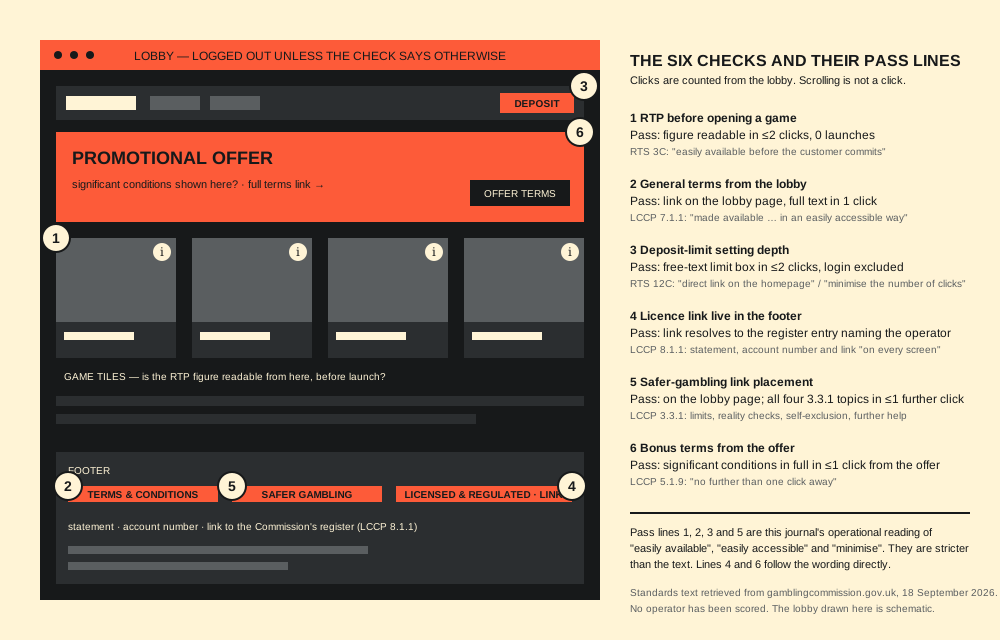
Six pieces of information a UK casino lobby is obliged to make reachable, the route to each on a desktop screen, a way of counting the distance, and the pass line drawn from the Gambling Commission’s own wording. The scoring table is published blank.
Why the lobby is measured against a document, not a taste
A casino lobby is a page that wants you to open a game. Everything else it must carry — the RTP figure, the general terms, the deposit-limit control, the licence statement, the route to help — competes with that purpose for space.
Where those things end up, and how many clicks stand between the lobby and each, is a design decision a reader can measure.
The measurement needs a standard, and there is one. Operators serving Great Britain hold Gambling Commission licences, and the Commission’s guide states that “Gambling software and remote operating licence holders (including ancillary remote betting) are required to comply with our remote technical standards (RTS)”. The Licence Conditions and Codes of Practice (LCCP) attach further conditions to the licence itself.
Both documents say, in places, where information must be and how reachable it must be. Some of that language is exact (“no further than one click away”); most of it is qualitative (“easily available”, “clearly visible”, “minimise the number of clicks”).
This page quotes the requirement behind each of six checks and turns each qualitative phrase into a numeric pass line that a second person can apply and get the same answer. Where the pass line is stricter than the wording, the text says so: a lobby can fail this method while remaining compliant, and the two must not be confused.
It scores nobody. The table at the end is blank, and the method is published first so that any later result can be checked against a version of the method that existed before it.
Sources: Remote gambling and software technical standards (guide).
The wording each of the six checks is measured against
- Check 1 — RTP
- RTS 3C: information that may reasonably be expected to influence a customer's decision must be "easily available before the customer commits to gamble".RTS 3 — Rules, game descriptions and the likelihood of winning · as checked on
- Check 2 — terms
- LCCP licence condition 7.1.1, which applies to all operating licences except gaming machine technical and gambling software licences.LCCP licence condition 7.1.1 — Fair and transparent terms and practices · as checked on
- Check 3 — deposit limits
- RTS 12C requires financial limit facilities "via a direct link on the homepage", and says the system "must minimise the number of clicks or pages".RTS 12 — Financial limits · as checked on
- Check 4 — licence link
- LCCP licence condition 8.1.1: a licensed-and-regulated statement, the account number and a Commission-supplied link, on every screen from which customers can access gambling facilities.LCCP licence condition 8.1.1 — Display of licensed status · as checked on
- Check 5 — safer gambling
- LCCP social responsibility code provision 3.3.1: information on how to gamble responsibly and how to access help must be "readily available".LCCP social responsibility code 3.3.1 — Responsible gambling information · as checked on
- Check 6 — bonus terms
- LCCP social responsibility code provision 5.1.9: where space limits an advert, "the significant conditions must be displayed in full no further than one click away".LCCP social responsibility code 5.1.9 — Other marketing requirements · as checked on
Quoted from the Commission's own documents. Where the pass line is stricter than the wording, the text says so.
The rules of the inspection
The method is fixed so that results from different lobbies, or the same lobby on different dates, can sit in one table. Every rule below is a choice, stated so that anyone who disagrees can change it and say so.
Device and viewport. A desktop browser at 1,280 CSS pixels or wider, 100 per cent zoom, browser name and version recorded. The same problem on a phone belongs to Pocket Casino Lab, which measures it for accessibility; its checks are not interchangeable with these.
Starting point. Every count begins on the lobby: the first page showing game tiles after arriving at the operator’s domain. A cookie banner or age gate is dismissed before counting and recorded.
Logged out first. Checks 1, 2, 4, 5 and 6 are run without an account. Check 3 is run logged in, with the login excluded from the count.
No deposit is made and no wager is placed. A check that cannot be completed without depositing is recorded as “not reachable without deposit”.
What counts as a click, and what the record must show
What counts as a click. Any pointer activation that changes what is on screen: following a link, opening a menu, expanding an accordion, opening a modal, switching a tab. Scrolling, hovering, closing a modal you opened and dismissing the cookie banner are not clicks, though scrolling is recorded.
Launching a game is a click and is also recorded as a launch, because check 1 turns on it.
What counts as “readable”. A figure or text that can be read without further action. A tooltip that needs a hover is not readable; the hover is recorded as a required action.
Record fields. Operator domain, date and time, browser, the route as a list of the visible labels clicked, the click count, whether scrolling or login was required, and the result against the pass line. Two inspectors on the same day should produce the same count; if not, the route list shows where they diverged.
A named limit. One route per check, the one the interface makes most obvious from the lobby. That is a judgement, and the route list records it so it can be disputed.
The rules of the inspection, as a card
Every rule is a choice, stated so that anyone who disagrees can change it and say so.
Ticks are kept only in this browser and are never sent anywhere.
Check 1: RTP visible before opening a game
RTS requirement 3C reads: “For each virtual event, game (including bingo), or lottery, information that may reasonably be expected to enable the customer to make an informed decision about his or her chances of winning must be easily available before the customer commits to gamble.
Information must include: a description of the way the game works and the way in which winners are determined and prizes allocated; house edge (or margin); the return to player (RTP) percentage or the probability (likelihood) of winning events occurring.” The page carrying it was last updated on 7 May 2024.
The trigger is “before the customer commits to gamble”, not before the game is opened; reading a game’s help page before staking satisfies it.
The implementation guidance confirms this: information “may be included in artwork and text displayed within the virtual game or event, in ‘help’ or ‘how to play’ pages, or other supporting material”, and “should be easily accessible, for example by placing links on home pages for gaming or virtual event sections, game selection pages or menus, or within individual games.” And the requirement is met by RTP or house edge or probability.
Sources: RTS 3 — Rules, game descriptions and the likelihood of winning.
Check 1: how to measure it, and the pass line
How to measure. From the lobby, take the first tile in the first row that is not a live-dealer game. Without launching it, try to reach a readable RTP, house edge or probability for that title: an information icon on the tile, a game detail page, a lobby-level game-information list.
Record the route, the click count and whether the figure was found without a launch. If not, launch the game, open its help panel, and record the clicks from launch to the figure. Record the figure and which of the three forms it took.
Pass line. The figure is readable in two clicks or fewer from the lobby with zero launches. A figure found only after launch is recorded as “launch required” with its click count and does not pass.
That is deliberately stricter than RTS 3C, which permits placement within the game; the design question here is whether the lobby lets a reader compare returns across games without opening each one, and the standard does not ask that.
What the figure means is the territory of Reel & Story. This check records only where it is and how far.
Sources: RTS 3 — Rules, game descriptions and the likelihood of winning.
Check 2: general terms reachable from the lobby
The general terms are the contract.
LCCP licence condition 7.1.1, which applies to all operating licences except gaming machine technical and gambling software licences, requires that “the contractual terms on which gambling is offered and any consumer notices relating to gambling activity must be transparent” within the meaning of the Consumer Rights Act 2015, and that those terms are “made available to customers in an easily accessible way”.
It also requires that “customers must be notified of material changes to terms before they come into effect”.
“Easily accessible” is not a number. The sector convention is a footer link, reachable from the lobby only after scrolling past the game grid, so the check records scrolling separately from clicking.
How to measure. From the lobby, logged out, find a link labelled with some form of “terms” (terms and conditions, T&Cs, general terms, house rules). Record where it sits: header, footer, account menu, or elsewhere.
Record whether reaching it required scrolling, and how many clicks it took to have the full terms text on screen. Record whether the document carries a version number or effective date, and whether it is one document or a set the reader must assemble.
Pass line. A terms link is present on the lobby page itself and the full text is on screen in one click. Scrolling is recorded, not failed.
A terms page that opens with a summary is counted at the clicks needed to reach the operative clauses.
What the clauses mean once you are inside is the territory of Terms in Plain Sight. This check ends when the document is on screen.
Sources: LCCP licence condition 7.1.1 — Fair and transparent terms and practices.
Check 3: how deep the deposit-limit setting sits
Of the six checks, this is the one where the standard comes closest to naming a number. RTS requirement 12C, on a page last updated on 31 October 2025, reads: “Financial limit facilities must be provided via a direct link on the homepage and be clearly visible and accessible.”
It continues: “Financial limit facilities must be clearly visible and accessible on deposit pages/screens or via a direct link on these pages or screens.”
And then: “The gambling system must minimise the number of clicks or pages customers make in order to access financial limit facilities.”
The implementation guidance adds that links should connect “directly to the facilities and not via a home page or other intermediate page(s), unless required by account log in security settings”.
RTS 12A sets the starting condition: “The gambling system must provide easily accessible facilities for customers to set their own financial limits at any time from the point of registration.”
RTS 12B specifies the control itself: “Customers must be presented with a ‘free text’ box to set a limit, or the equivalent in the case of telephone gambling.”
RTS 12E makes setting a limit the default at the point of first deposit: “Financial limit-setting facilities must present setting a limit as the default choice. The gambling system must require an action by the customer in order to decline setting a limit.”
Sources: RTS 12 — Financial limits.
RTS 12, requirement by requirement
| Requirement | What it says | Evidence |
|---|---|---|
| RTS 12A | “The gambling system must provide easily accessible facilities for customers to set their own financial limits at any time from the point of registration.” | · RTS 12 — Financial limits |
| RTS 12B | “Customers must be presented with a ‘free text’ box to set a limit, or the equivalent in the case of telephone gambling.” | · RTS 12 — Financial limits |
| RTS 12C | “Financial limit facilities must be provided via a direct link on the homepage and be clearly visible and accessible.” | · RTS 12 — Financial limits |
| RTS 12E | “Financial limit-setting facilities must present setting a limit as the default choice. The gambling system must require an action by the customer in order to decline setting a limit.” | · RTS 12 — Financial limits |
Two clicks is this journal's reading of "minimise". The standard states no number.
Check 3: how to measure it, and the two-click pass line
How to measure. Log in and return to the lobby. Count the clicks until a free-text deposit-limit box is on screen, recording the route by label.
Then go to the deposit screen (without depositing) and count the clicks from there to the same box. Record whether the lobby carries a direct link to limits, as 12C requires of the homepage, or whether the route runs through an account menu or settings tree, and whether the box is free-text or a fixed set of amounts.
Pass line. The free-text limit box is on screen in two clicks or fewer from the lobby, login excluded, and one click or fewer from the deposit screen. A limit control that appears only as a drop-down of preset amounts with no free-text entry is recorded as “preset only” and does not pass.
The registration-time prompt required by 12A and 12E is recorded as “not checked” unless a registration was performed and documented.
Two clicks is this journal’s reading of “minimise”. The standard states no number, and an operator at three clicks is not, on this page’s evidence, non-compliant. What a limit does once set is the territory of Play in Balance.
Sources: RTS 12 — Financial limits.
Check 4: the licence link in the footer is live
LCCP licence condition 8.1.1 applies to “all remote casino, bingo and betting licences other than ancillary, host, remote betting intermediary (trading room only), remote general betting (limited) and remote general betting (standard) (remote platform) licences”.
It reads: “Licensees providing facilities for remote gambling must display on every screen from which customers are able to access gambling facilities provided in reliance on this licence: a statement that they are licensed and regulated by the Gambling Commission; their account number; and a link (which will be supplied by the Commission) to their current licensed status as recorded on the Commission’s website.”
Three things, then, on every screen. Paragraph 3 also permits the display of licences from other jurisdictions, “provided it is made plain on those screens that the licensee provides facilities for gambling to persons in Great Britain in reliance on their Gambling Commission licence(s)”.
A foreign badge shown more prominently than the Commission statement is not thereby non-compliant, but the check records the ordering.
How to measure. On the lobby, logged out, scroll to the footer. Record whether the statement, account number and link are present.
Click the link and record where it lands: the licensee’s register entry, the register search page, the Commission’s homepage, a 404, or elsewhere. On a register entry, record the name shown, whether it matches the trading name on the lobby, and the status.
Then open one game page and one account page and confirm the same three elements are there, since the condition says “every screen”.
Pass line. All three elements are present on the lobby, and the link resolves to a register entry that names the operator and shows a current status. A link that resolves to the Commission’s homepage or to the register search page is recorded as “present, not direct” and does not pass.
A dead link is recorded as such and does not pass.
Reading the register entry itself is the territory of Licence Lens. This check confirms the link works and lands where the condition says it should.
Sources: LCCP licence condition 8.1.1 — Display of licensed status.
Three things, then, on every screen
LCCP licence condition 8.1.1, on every screen from which customers are able to access gambling facilities provided in reliance on this licence.
Ticks are kept only in this browser and are never sent anywhere.
Check 5: where the safer-gambling link sits and what it reaches
LCCP social responsibility code provision 3.3.1 requires that “licensees must make information readily available to their customers on how to gamble responsibly and how to access information about, and help in respect of, problem gambling.”
It lists what the information must cover: “any measures provided by the licensee to help individuals monitor or control their gambling, such as restricting the duration of a gambling session or the amount of money they can spend”; “timers or other forms of reminders or ‘reality checks’ where available”; “self-exclusion options”; and “information about the availability of further help or advice”.
It adds that the information “must be directed to all customers whether or not licensees also make available material which is directed specifically at customers who may be ‘problem gamblers’.”
Paragraph 4 gives detailed placement rules for gambling premises and none for a website. “Readily available” is the whole of the online placement requirement, so this method records a position and a coverage count rather than pretending the standard names a location.
How to measure. On the lobby, logged out, find the safer-gambling link (labels vary: safer gambling, responsible gambling, play safe, gambling controls). Record its position and whether it was visible without scrolling.
Click it. On the destination page, look for each of the four 3.3.1 topics and record whether each is on that page or one further click away, giving a coverage count from 0 to 4.
Pass line. The link is on the lobby page and all four topics are reachable from the destination in one further click or fewer: coverage 4. A footer-only link still passes; the scroll is recorded.
A page that links out to a third party for all four is recorded as “external for all four” and flagged.
Sources: LCCP social responsibility code 3.3.1 — Responsible gambling information.
The four topics safer-gambling information must cover
Listed in LCCP social responsibility code provision 3.3.1, in the code's own words.
Ticks are kept only in this browser and are never sent anywhere.
Check 6: bonus terms one click from the offer
The one place the LCCP states a click count is marketing. Social responsibility code provision 5.1.9, which applies to all licences, reads in paragraph 2: “Licensees must ensure that all significant conditions which apply to marketing incentives are provided transparently and prominently to consumers.
Licensees must present the significant conditions at the point of sale for any promotion, and on any advertising in any medium for that marketing incentive except where, in relation to the latter, limitations of space make this impossible.
In such a case, information about the significant conditions must be included to the extent that it is possible to do so, the advertising must clearly indicate that significant conditions apply and where the advertisement is online, the significant conditions must be displayed in full no further than one click away.”
Paragraph 3 adds that “the terms and conditions of each marketing incentive must be made available for the full duration of the promotion.”
Paragraph 1 ties all of it to the Digital Markets, Competition and Consumers Act 2024: marketing must not “amount to or involve misleading actions or misleading omissions within the meaning of this Act”.
That is a default and an exception: conditions on the advert itself, or, where space prevents it, one click away online with the advert indicating that conditions apply. A lobby banner is an online advert with limited space, so the one-click rule is the operative test.
Sources: LCCP social responsibility code 5.1.9 — Other marketing requirements.
Check 6: how to measure it, and the pass line
How to measure. On the lobby, logged out, take the first promotional banner or tile that describes a marketing incentive. Record what the banner states: any figure, any indication that conditions apply, any conditions in the banner text.
Click its terms link, or the banner itself if there is none. Record what is on screen after one click — the full significant conditions, a summary with a further link, a registration form, a promotions page — and count clicks until the full conditions for that offer are on screen.
Pass line. The banner indicates that conditions apply, and the full significant conditions for that offer are on screen in one click. This is the standard’s own number, not this journal’s.
A route that reaches a promotions page after one click and the specific conditions after two is recorded as two and does not pass. Which terms count as significant is Terms in Plain Sight’s territory; this check records distance and signal.
Sources: LCCP social responsibility code 5.1.9 — Other marketing requirements.
The blank scoring table and what a score cannot say
The table below is the artefact: six rows, the standard in short form, the measurement, the pass line, and an empty result column. Nothing on this page reports an inspection, because none has been recorded yet, and a method that arrives with results attached invites the suspicion that the results shaped the method.
How a completed row is written. A result is one of: pass, fail, launch required (check 1), preset only (check 3), present but not direct (check 4), not reachable without deposit, or not checked. The route column carries the labels clicked in order, the browser and the time.
A row without a route is not a result.
What a completed table cannot say. Six passes do not make a lobby fair or safe, and a fail is not a finding of non-compliance: four of the six pass lines are stricter than the text, and a lobby can fail check 1 by placing RTP inside the game exactly as RTS 3C guidance describes.
The table measures distance on one desktop route on one day, not whether the information is accurate or the terms are fair.
What changes the method. If the Commission amends RTS 3, RTS 12 or the LCCP provisions quoted here, the pass lines drawn from them are re-derived and the version number in the caption changes. Results recorded under version 1 stay labelled as such.
The pages quoted carried these “last updated” dates when retrieved: RTS 3, 7 May 2024; RTS 12, 31 October 2025; the RTS guide page, 29 January 2026.
The desktop worksheet already on this site examines a different layer of the same lobby — labels, keyboard focus, zoom and recovery paths. This page adds the six pieces of information the lobby is obliged to carry and a way of saying, in clicks, how far away it put them.
| # | Check | Standard (short form) | What is counted | Pass line | Stricter than the text? | Result | Route / notes | Evidence |
|---|---|---|---|---|---|---|---|---|
| 1 | RTP visible before opening a game | RTS 3C: RTP, house edge or probability “easily available before the customer commits to gamble” | Clicks from lobby to a readable figure; launches required | ≤ 2 clicks, 0 launches | Yes — guidance permits placement within the game | — | — | · RTS 3 — Rules, game descriptions and the likelihood of winning |
| 2 | General terms reachable from the lobby | LCCP 7.1.1: terms “made available to customers in an easily accessible way” | Link position; scroll needed; clicks to full text; version date present | Link on lobby page; full text in 1 click | Yes — “easily accessible” is not quantified | — | — | · LCCP licence condition 7.1.1 — Fair and transparent terms and practices |
| 3 | Deposit-limit setting depth | RTS 12C: “direct link on the homepage”; “minimise the number of clicks or pages”; RTS 12B: free-text box | Clicks from lobby (logged in, login excluded) and from deposit screen to free-text limit box | ≤ 2 from lobby; ≤ 1 from deposit screen; free-text present | Partly — the click limit is this journal’s; the direct link and free-text box are the text’s | — | — | · RTS 12 — Financial limits |
| 4 | Licence link live in footer | LCCP 8.1.1: statement, account number and register link “on every screen” | Presence of all three; link destination; name match; status shown | All three present; link resolves to a register entry naming the operator | No | — | — | · LCCP licence condition 8.1.1 — Display of licensed status |
| 5 | Safer-gambling link placement | LCCP 3.3.1: information “readily available”, covering limits, reality checks, self-exclusion, further help | Link position; scroll needed; coverage of four topics within 1 further click | Link on lobby page; coverage 4 of 4 | Yes — no online placement rule exists in the text | — | — | · LCCP social responsibility code 3.3.1 — Responsible gambling information |
| 6 | Bonus terms one click from the offer | LCCP 5.1.9: significant conditions “no further than one click away”; advert must indicate conditions apply | Whether banner signals conditions; clicks to full significant conditions for that offer | Signal present; full conditions in ≤ 1 click | No | — | — | · LCCP social responsibility code 5.1.9 — Other marketing requirements |
How to run a check and record the row
The method as the rules above set it out, in the order an inspection runs. Two inspectors on the same day should produce the same count.
Set the device
A desktop browser at 1,280 CSS pixels or wider, 100 per cent zoom, browser name and version recorded.
Start on the lobby
Every count begins on the lobby: the first page showing game tiles after arriving at the operator's domain. A cookie banner or age gate is dismissed before counting and recorded.
Stay logged out, except for check 3
Checks 1, 2, 4, 5 and 6 are run without an account. Check 3 is run logged in, with the login excluded from the count. No deposit is made and no wager is placed.
Count only what changes the screen
Any pointer activation that changes what is on screen: following a link, opening a menu, expanding an accordion, opening a modal, switching a tab. Scrolling, hovering, closing a modal you opened and dismissing the cookie banner are not clicks, though scrolling is recorded.
Write the row
A result is one of: pass, fail, launch required (check 1), preset only (check 3), present but not direct (check 4), not reachable without deposit, or not checked. The route column carries the labels clicked in order, the browser and the time. A row without a route is not a result.
What the result means
Six passes do not make a lobby fair or safe, and a fail is not a finding of non-compliance. The table measures distance on one desktop route on one day, not whether the information is accurate or the terms are fair.
The words this method uses precisely
- Lobby
- The first page showing game tiles after arriving at the operator's domain. Every count on this page begins there.
- Click
- Any pointer activation that changes what is on screen. Scrolling, hovering and dismissing a cookie banner are not clicks, though scrolling is recorded.
- Readable
- A figure or text that can be read without further action. A tooltip that needs a hover is not readable; the hover is recorded as a required action.
- Pass line
- The numeric line this page sets for a qualitative phrase in the standard, so that a second person can apply it and get the same answer.
- RTS
- The Gambling Commission's remote technical standards, which remote operating and gambling software licence holders are required to comply with.
- LCCP
- The Licence Conditions and Codes of Practice, which attach further conditions to the licence itself.
Questions answered
How do you navigate an online casino lobby?
Treat the lobby as three bands: a header carrying the deposit control and account menu, a game grid that fills most of the page, and a footer carrying the terms, safer-gambling and licence links. The information a player is entitled to under UK standards sits mostly at the edges — game information on the tile or inside the game, limits behind the account or deposit control, and the contract and licence statement in the footer — so a first visit is quickest if you scroll to the footer before opening anything.
Where do casinos show RTP?
Under RTS 3C the RTP percentage (or house edge, or probability of winning) must be “easily available before the customer commits to gamble”, and the guidance allows it in the game’s own help or how-to-play page, on game selection pages, or in lobby-level links. In practice that means an information icon on the tile, a game detail page, or the help panel after launch; which of those a given lobby uses is what check 1 of this method records.
How do I find a casino’s terms and conditions?
Look in the footer of the lobby for a link labelled terms and conditions, T&Cs or general terms; LCCP licence condition 7.1.1 requires the terms to be “made available to customers in an easily accessible way”, and the footer is the sector convention. For a specific bonus, the offer’s own banner or tile must indicate that conditions apply and, under LCCP 5.1.9, the significant conditions must be “no further than one click away” online.
Does a lobby that fails this method break the rules?
No. Where the pass line is stricter than the wording, the text says so: a lobby can fail this method while remaining compliant, and the two must not be confused.
How far from the lobby should a deposit limit be?
Two clicks is this journal’s reading of “minimise”. The standard states no number, and an operator at three clicks is not, on this page’s evidence, non-compliant.
Design sources
- RTS 3 — Rules, game descriptions and the likelihood of winning
- RTS 12 — Financial limits
- LCCP social responsibility code 5.1.9 — Other marketing requirements
- LCCP licence condition 8.1.1 — Display of licensed status
- LCCP social responsibility code 3.3.1 — Responsible gambling information
- LCCP licence condition 7.1.1 — Fair and transparent terms and practices
- Remote gambling and software technical standards (guide)
Continue reading
Reading a casino route: a wayfinding worksheet
Follow the decisions a room asks you to make. This worksheet turns a casino design description into questions that can be checked.
Read Reading a casino route: a wayfinding worksheet
A casino marketing screen needs to show both what and how
An interface inspection of product choices, contact channels and confirmation steps, using a fictional preference screen and the published consent requirements.
Read A casino marketing screen needs to show both what and how
What online casino game offers the highest RTP?: where it sits and how many clicks it takes
No sheet can name the highest-RTP game across every lobby, because the figure is published per game, inside that game's own rules or information panel. This sheet records where the Gambling Commission's technical standards require the figure to sit and how far away the rules allow it to be. It then reads two games' figures side by side in pounds.
Read What online casino game offers the highest RTP?: where it sits and how many clicks it takes
Bellagio’s ceiling and the casino resort entrance
Chihuly’s Fiori di Como, made for the lobby in 1998, sends the eye up. This sheet runs 6 checks on that arrival space, then the same 6 on a screen.
Read Bellagio’s ceiling and the casino resort entrance
Two casino layouts, two different design problems
Design At Source’s Birmingham and Sheffield accounts describe different priorities. Reading their briefs explains more than comparing decorative styles.
Read Two casino layouts, two different design problems
The casino balance is only one number on the screen
An interface reading method separates balances, net deposits and session results, with a worked fictional account and the UK rules behind the labels.
Read The casino balance is only one number on the screen
Continue reading
What online casino game offers the highest RTP?: where it sits and how many clicks it takes
No sheet can name the highest-RTP game across every lobby, because the figure is published per game, inside that game's own rules or information panel. This sheet records where the Gambling Commission's technical standards require the figure to sit and how far away the rules allow it to be. It then reads two games' figures side by side in pounds.
Read What online casino game offers the highest RTP?: where it sits and how many clicks it takesA casino marketing screen needs to show both what and how
An interface inspection of product choices, contact channels and confirmation steps, using a fictional preference screen and the published consent requirements.
Read A casino marketing screen needs to show both what and howReading a casino route: a wayfinding worksheet
Follow the decisions a room asks you to make. This worksheet turns a casino design description into questions that can be checked.
Read Reading a casino route: a wayfinding worksheetA casino space observation checklist
Bellagio’s ceiling and the casino resort entrance
Reading a casino route: a wayfinding worksheet
Two casino layouts, two different design problems
The casino balance is only one number on the screen
A casino marketing screen needs to show both what and how
How do you assess an online casino’s desktop interface?
What online casino game offers the highest RTP?: where it sits and how many clicks it takes