Facts checked Article
Physical casino design
A casino marketing screen needs to show both what and how
An interface inspection of product choices, contact channels and confirmation steps, using a fictional preference screen and the published consent requirements.
Find the choice behind the switch
A single switch labelled “Offers” cannot, by itself, tell a reader which gambling products or contact channels it controls. The relevant Gambling Commission provision requires covered remote operators to offer marketing choices by product and by channel. For an interface reader, the first task is therefore to find two kinds of information: what the messages concern and how they arrive.
This is a document-based inspection method for adult readers. No casino account was opened, no preferences were changed and no number of clicks at a named operator was measured. The examples below are deliberately fictional.
They show how to read the information architecture of a settings screen without treating an attractive switch as evidence of a complete choice.
The focus is the screen’s labels, grouping and confirmation language. It is not an assessment of whether a particular operator has lawfully processed someone’s data. That would require the relevant account record and circumstances.
A useful interface observation can nevertheless be precise: identify the choice that is visible, the relationship that is unclear and the text needed to resolve it.
Sources: 5.1.12 Direct marketing preferences.
Check sheet: what the provisions require
- Choices by product and by channel
- The relevant Gambling Commission provision requires covered remote operators to offer marketing choices by product and by channel: what the messages concern and how they arrive.5.1.12 Direct marketing preferences · as checked on
- Default state
- Provision 5.1.12 describes options set to opt-out by default, available at registration and updateable later.5.1.12 Direct marketing preferences · as checked on
- Named channels and products
- Calls, email and SMS where applicable; betting, casino and bingo where applicable. Operators must explain which products fall under their categories.5.1.12 Direct marketing preferences · as checked on
- The confirmation step
- Where an operator uses an additional confirmation step, it should ask for confirmation of the chosen preferences with one click to proceed, without encouraging a change of selection.5.1.12 Direct marketing preferences · as checked on
- Withdrawal
- The electronic-marketing consent provision requires an opportunity to withdraw consent when a consumer is contacted; the licensee must stop electronic marketing as soon as practicable after withdrawal and be able to evidence consent.5.1.11 Direct electronic marketing consent · as checked on
Document-based inspection. No casino account was opened, no preferences were changed and no click count at a named operator was measured.
Read the provision before designing a checklist
Social responsibility code provision 5.1.12 covers the specified remote casino, bingo and betting licences, with listed exceptions. It describes options set to opt-out by default, available at registration and updateable later. Its named channels include calls, email and SMS where applicable; its product categories include betting, casino and bingo where applicable.
Operators must explain which products fall under their categories.
That last point turns a category label into a design question. Suppose a fictional menu says “Games”. A reader cannot assume that it means casino only, or that bingo is included.
The inspection should record the label and look for its explanation. It should not silently translate an ambiguous word into the category the reviewer expected to find.
Likewise, a channel headed “Mobile” leaves an unresolved question if its description does not distinguish a call from a text. This is a hypothetical example of ambiguity, not a finding against an operator. The method begins with the wording that is actually visible and asks what choice that wording allows a person to make.
It does not assign a numerical quality score merely because one design uses more switches than another.
Sources: 5.1.12 Direct marketing preferences.
Use a matrix to expose an ambiguous relationship
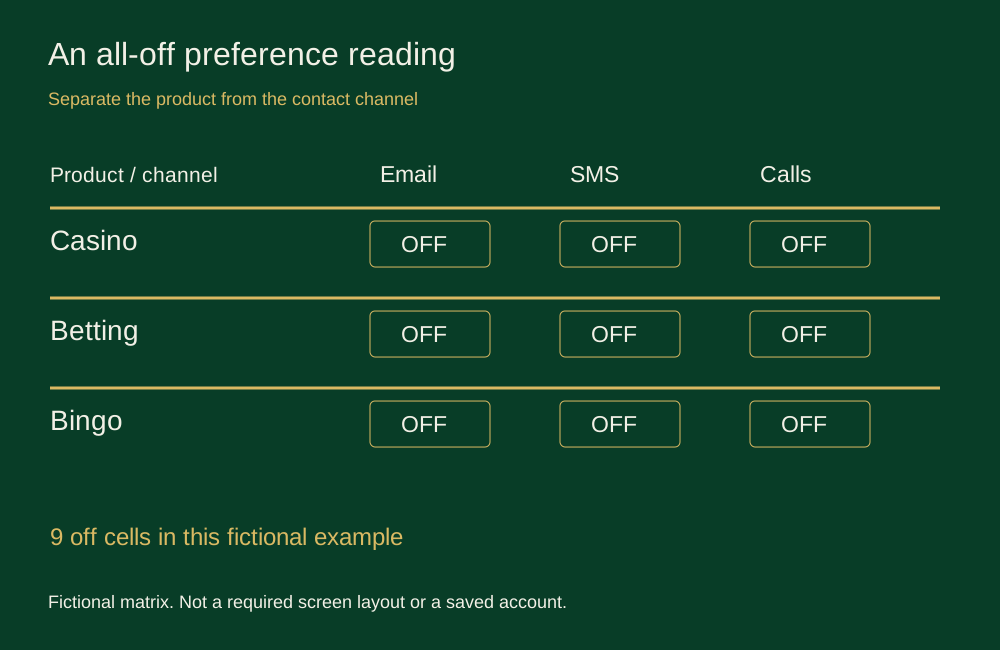
Imagine a fictional screen with three product rows and three contact columns. All nine cells begin off. The rows are casino, betting and bingo; the columns are email, SMS and phone call.
A reader wants every marketing choice to remain off. In this example the intended result is simple: nine off states, followed by a confirmation that preserves them.
The matrix is our analysis tool, not a statutory demand for nine physical switches. Another interface might express choices through two grouped lists. The question is whether the resulting permissions are understandable, not whether the page resembles our drawing.
If the screen groups products separately from channels, its explanation must be read before inferring which combinations follow.
Now consider a second fictional request: permit casino email only. That changes one cell of our example matrix and leaves eight off. We use this solely to test whether a screen can express a specific choice, not to encourage marketing subscriptions.
If the interface cannot explain whether selecting email also selects every product, the inspection has found an unanswered relationship. The honest result is “scope unclear”, not an invented account setting.
The original figure shows the all-off matrix. Its labels illustrate the two axes of the choice. It contains no live controls, operator branding or claim that an account has been configured.
| Fictional product | SMS | Phone call | |
|---|---|---|---|
| Casino | Off | Off | Off |
| Betting | Off | Off | Off |
| Bingo | Off | Off | Off |
The confirmation page is part of the interface
Provision 5.1.12 also addresses an additional confirmation step. Where an operator uses one, the text and structure should ask for confirmation of the chosen preferences with one click to proceed, without encouraging a change of selection. That rule concerns this particular step; it is not a one-click limit for finding every settings page.
Compare two invented confirmations. “Save these choices” followed by a neutral accept or decline option gives a reviewer a clear task to examine. “Are you sure you want to miss our offers?” adds an attempt to reconsider the choice.
The example is a reading exercise, not an observed screen or a legal ruling on a named business.
A record of the first page alone would miss this difference. The proposed inspection follows the displayed choices into the confirmation language, noting whether the same product and channel scope remains visible. It also records what has not been observed.
A public help article may describe a process without displaying its final screen; that is a documented route, not a completed account inspection. Keep those evidence types separate.
Sources: 5.1.12 Direct marketing preferences.
Words on the sheet
- Social responsibility code provision
- A rule in the Commission's codes that licensed operators must follow; provision 5.1.12 is the one on marketing preferences.
- Opt-out default
- A choice that starts in the off state, so marketing arrives only if the person switches it on.
- Channel
- How a message arrives: a call, an email or an SMS.
- Product scope
- Which gambling products a marketing choice covers, such as casino, betting or bingo, as the screen explains them.
- Additional confirmation step
- A page after the choices are made that asks the person to confirm them; the provision says one click should be enough to proceed.
- Affirmative choice
- The ICO's standard for consent: a positive action by the person, which a pre-ticked box does not supply.
Consent should remain separate from the contract
The Information Commissioner’s Office describes consent as an affirmative choice and says pre-ticked opt-in boxes do not meet that standard. Its guidance also distinguishes consent from general terms and conditions. These principles explain why proximity matters: a box accepting account terms should not be casually read as the same thing as a marketing preference.
In a fictional registration panel, place “I accept the account terms” above “Email me casino promotions”. Those sentences concern different decisions even if the designer aligns them in one column. A reviewer should copy both labels into the evidence record and note the grouping.
Do not assume that separate rows necessarily mean separate choices if a single control governs them.
The ICO’s detailed consent guidance recommends concise language, consistent methods and avoidance of confusing double negatives. A switch labelled “Do not stop sending messages” is consequently a poor sentence to interpret at speed. Our editorial preference is to write the intended state in plain words before discussing the control: “email marketing off”.
That is a proposed clarity technique, not a quotation from the regulator.
The ICO pages carried a notice that guidance was under review following the Data (Use and Access) Act. The record here reflects the pages retrieved on 19 September 2026; a later review should recheck them.
Sources: Consent; How should we obtain, record and manage consent?.
Registration panel: what to copy into the record
A fictional panel with an account-terms box above a marketing choice. The two sentences concern different decisions even when they sit in one column.
Ticks are kept only in this browser and are never sent anywhere.
Follow the route back out
The Commission’s electronic-marketing consent provision requires an opportunity to withdraw consent when a consumer is contacted. It says the licensee must stop electronic marketing as soon as practicable after withdrawal unless the consumer consents again, and must be able to evidence consent. It does not supply a universal number of minutes in which every downstream message will cease.
That distinction prevents a settings observation becoming an unsupported delivery claim. A screen may display “saved”, but our inspection has not thereby established what every mailing system holds or when a queued message was prepared. Record the visible confirmation and its time separately from any message later received.
The two records can support a clear query without pretending to reveal the operator’s internal processing.
The ICO’s management guidance says withdrawal should be as easy as giving consent. Read that alongside the route actually documented: where the setting is named, whether the explanation identifies the relevant organisation, and how the person is told to change it. Do not create an account or subscribe to promotions merely to complete a comparison.
A missing public view remains a limitation.
Turning off marketing is also a different task from changing account access or gambling limits. This inspection makes no claim that an off switch blocks gambling. Its purpose is to understand communications choices.
Sources: 5.1.11 Direct electronic marketing consent; How should we obtain, record and manage consent?.
Write a finding another reader can reproduce
A useful observation sheet contains six fields: the page or document inspected, the observation date, the exact control label, the stated product scope, the stated channel scope and the confirmation text. Add a final field for uncertainty. In a real private account review, account identifiers should stay out of a public report.
Here is an invented completed entry. The help document describes an account menu called “Communication choices”. It names email and SMS but uses “Games” without explaining whether that includes bingo.
It says changes can be saved, but does not reproduce the confirmation page. The resulting finding is narrow: the public document describes a route and two channels, while product coverage and the final screen remain unverified.
It would be inaccurate to turn that record into “the operator hides settings” or “the operator sends unwanted bingo emails”. Neither event was observed. The next useful question is simply which products “Games” covers and where the confirmation wording can be inspected.
This is where information architecture becomes a consumer problem. A preference is useful only when its scope can be understood. Product, channel, state and confirmation belong in the same reading, even when the interface distributes them across several panels.
Our method gives the reader a way to describe an ambiguity without inventing a test result or mistaking a marketing control for a broader safety measure.
How to inspect a casino marketing screen
The method the sheet above describes, in the order the screens are met. Every example is fictional; nothing here is an observed operator page.
Find what and how
Locate the two kinds of information first: what the messages concern and how they arrive. A switch labelled Offers cannot tell you either by itself.
Record the label, then its explanation
Copy the visible wording, such as Games or Mobile, and look for the text that explains it. Do not translate an ambiguous word into the category you expected to find.
Test the choice against the matrix
Ask whether the screen can express nine off states, or casino email only, and whether selecting a channel also selects every product. If it cannot say, the honest result is scope unclear.
Follow the choices into the confirmation
Note whether the same product and channel scope remains visible on the confirmation page, and whether the wording encourages a change of selection.
Keep consent apart from the terms
Where an account-terms box sits beside a marketing choice, copy both labels and note the grouping.
Record the route back out
Note where the setting is named, whether the explanation identifies the relevant organisation, and how the person is told to change it. Record the visible confirmation and its time separately from any message later received.
What the result means
A narrow finding: the document describes a route and the channels it names, while anything not displayed stays unverified. It is not evidence that an operator hides settings or sends unwanted messages, and an off state says nothing about gambling limits or account access.
The observation sheet: seven fields
Six fields plus one for uncertainty. In a real private account review, account identifiers stay out of a public report.
Ticks are kept only in this browser and are never sent anywhere.
Questions answered
Can I choose which gambling products send me marketing?
The Commission’s 5.1.12 provision requires covered remote operators to provide choices by product and channel. The applicable categories and their contents should be clear; this does not mean every operator must use our example matrix.
Should casino marketing boxes be pre-ticked?
The relevant Commission provision says its options must default to opt-out. The ICO separately says pre-ticked opt-in boxes do not constitute valid consent.
Does accepting account terms also mean accepting marketing?
Do not treat the two as interchangeable. The ICO says consent should be separate from other terms and conditions; inspect the distinct wording and choices presented.
Must every casino setting be reachable in one click?
The one-click wording discussed here concerns an additional confirmation step for marketing preferences. It is not a general rule that every setting must be one click from a homepage.
Does turning off marketing stop me gambling?
This article’s controls concern communications. It does not test self-exclusion, account closure or gambling limits, and an off state in its fictional matrix establishes none of those outcomes.
What should an observation sheet for a marketing screen record?
Six fields: the page or document inspected, the observation date, the exact control label, the stated product scope, the stated channel scope and the confirmation text, with a final field for uncertainty.
Does a saved preference prove that marketing has stopped?
No. A screen may display saved, but that does not establish what every mailing system holds or when a queued message was prepared. Record the visible confirmation and its time separately from any message later received.
Design sources
Continue reading
Reading a casino route: a wayfinding worksheet
Follow the decisions a room asks you to make. This worksheet turns a casino design description into questions that can be checked.
Read Reading a casino route: a wayfinding worksheet
What online casino game offers the highest RTP?: where it sits and how many clicks it takes
No sheet can name the highest-RTP game across every lobby, because the figure is published per game, inside that game's own rules or information panel. This sheet records where the Gambling Commission's technical standards require the figure to sit and how far away the rules allow it to be. It then reads two games' figures side by side in pounds.
Read What online casino game offers the highest RTP?: where it sits and how many clicks it takes
How to find RTP and terms inside an online casino, and how far away they are allowed to be
Six pieces of information a UK casino lobby is obliged to make reachable, the route to each on a desktop screen, a way of counting the distance, and the pass line drawn from the Gambling Commission’s own wording. The scoring table is published blank.
Read How to find RTP and terms inside an online casino, and how far away they are allowed to be
Bellagio’s ceiling and the casino resort entrance
Chihuly’s Fiori di Como, made for the lobby in 1998, sends the eye up. This sheet runs 6 checks on that arrival space, then the same 6 on a screen.
Read Bellagio’s ceiling and the casino resort entrance
Two casino layouts, two different design problems
Design At Source’s Birmingham and Sheffield accounts describe different priorities. Reading their briefs explains more than comparing decorative styles.
Read Two casino layouts, two different design problems
The casino balance is only one number on the screen
An interface reading method separates balances, net deposits and session results, with a worked fictional account and the UK rules behind the labels.
Read The casino balance is only one number on the screen
Continue reading
What online casino game offers the highest RTP?: where it sits and how many clicks it takes
No sheet can name the highest-RTP game across every lobby, because the figure is published per game, inside that game's own rules or information panel. This sheet records where the Gambling Commission's technical standards require the figure to sit and how far away the rules allow it to be. It then reads two games' figures side by side in pounds.
Read What online casino game offers the highest RTP?: where it sits and how many clicks it takesReading a casino route: a wayfinding worksheet
Follow the decisions a room asks you to make. This worksheet turns a casino design description into questions that can be checked.
Read Reading a casino route: a wayfinding worksheetHow to find RTP and terms inside an online casino, and how far away they are allowed to be
Six pieces of information a UK casino lobby is obliged to make reachable, the route to each on a desktop screen, a way of counting the distance, and the pass line drawn from the Gambling Commission’s own wording. The scoring table is published blank.
Read How to find RTP and terms inside an online casino, and how far away they are allowed to beA casino space observation checklist
Bellagio’s ceiling and the casino resort entrance
Reading a casino route: a wayfinding worksheet
Two casino layouts, two different design problems
How to find RTP and terms inside an online casino, and how far away they are allowed to be
The casino balance is only one number on the screen
How do you assess an online casino’s desktop interface?
What online casino game offers the highest RTP?: where it sits and how many clicks it takes